Monday, 16 September 2013

A world without waste - it really can happen!

Gardening Australia had several outstanding stories this week about innovation and sustainability in action, with another look at Sundrop farm that we featured in an earlier blog. The story that has particular relevance to Archibull is about the amazing sustainability innovator Joost Bakker, in a segment called "Closing the loop". He has amazing ways of creating the most incredibly sustainable cafes and he produces no waste from his business. Garbage bins are not needed.You can watch it at the link below:

http://www.abc.net.au/gardening/video/default.htm?clip=http://mpegmedia.abc.net.au/tv/gardeningaus/prog_streams/closingloop_ep26_2013.mp4&title=Closing
the Loop


Closed Loop Organics units are fully contained, commercial on-site composting units that can reduce food waste volume by up to 90 per cent in 24 hours.


The segment about Sundrop farm is called "The way of the Future" and can be viewed at the link
 http://www.abc.net.au/gardening/video/default.htm?clip=http://mpegmedia.abc.net.au/tv/gardeningaus/prog_streams/closingloop_ep26_2013.mp4&title=Closing the Loop.

This report includes the growing medium and use of bees for pollination in the greenhouse and is definitely worth a look.
Also the wonderful permaculture gardens that have been created at schools in the Illawarra were featured along with the very important research being conducted by the University of Western Sydney into the long term effects of elevated carbon dioxide on native plants.
 
We also found this information in our research which although the design is American we thought it was relevant to Archibull - composting inspired by ruminant digestion!!!!
 
C.O.W.S. Turn Food Waste into Hot Water
COWS C.O.W.S. Turn Food Waste into Hot Water
Closed-loop composting system draws inspiration from the inner workings of ruminants
A team of entrepreneurial urban cowboys at a Michigan-based startup wants to put COWS into supermarkets and cafeterias across the country. They don’t mean the gassy, grass-gnashing farm animals. Rather, it’s a technology they call COWS (Compact Organic Waste System) that draws its inspiration from the inner workings of ruminants.
COWS is a small-scale, on-site composting system developed by University of Michigan graduate students who went on to form the startup ReGenerate Solutions. The anaerobic digester converts discarded food into methane, mimicking how real-life cows digest their meals: anaerobic organisms in their stomachs break down cellulose and create methane as a byproduct. In ReGenerate’s concept, the methane gas will be burned to heat water in the same building where the COWS equipment is located—making for a neat, closed-loop waste-management system.
Each year, “a single COWS unit eliminates more than 170 tons of landfill waste, reduces greenhouse gas emissions by the equivalent of 300 metric tons of CO2, and produces over 400 million BTUs of biogas,” reports ReGenerate. Operating at full capacity, one composter can process up to 1,000 pounds of waste—fruits, vegetables, meat, dairy, cardboard, and potentially compostable dishware—per day.
 
 
A note to blogger - you should have subscript options so that chemical formulas can be written correctly!

Monday, 9 September 2013

Natural Resource management workers

Megan Rowlatt demonstrates to our team how to remove asparagus fern (photo Lynne Strong)

 Megan working in our Burrawong Mia Mia indigenous garden (Photo Lynne Strong)
 

Megan shows us how weeds can be identified (Photo Lynne Strong)
 

We thought we would start this section of our blog with our edited version of our interview with our very inspiring Young Eco Champion Megan Rowlatt.

Megan is the Illawarra Local Land Services Officer and you can view our video at

http://youtu.be/MyXszsN-DXo

Tuesday, 3 September 2013

Natural Resource Management

What is Natural Resource Management?

Our natural resources include our water, soil, plants and animals and the people who depend on them; our farmers, landholders, rural and urban communities need to manage their interactions with natural resources in a sustainable way. 
Natural resource management (NRM) is about managing the way in which people and natural landscapes interact. NRM brings together the planning, allocation, conservation and use of all natural resources to secure a sustainable and prosperous  Australia where a healthy environment is the basis for a good quality of life for all.
 
 
Sustainable Land Management
 

SLM can be defined as “the use of land resources, including soils, water, animals and plants, for the production of goods to meet changing human needs, while simultaneously ensuring the long-term productive potential of these resources and the maintenance of their environmental functions” (UN Earth Summit, 1992). TerrAfrica (2005) has further defined sustainable land management as “the adoption of land use systems that, through appropriate management practices, enables land users to maximize the economic and social benefits from the land while maintaining or enhancing the ecological support functions of the land resources”.

Sustainable Land Management (SLM) is crucial to minimizing land degradation, rehabilitating degraded areas and ensuring the optimal use of land resources for the benefit of present and future generations.
SLM is based on four common principles:

 
• land-user-driven and participatory approaches;
• integrated use of natural resources at ecosystem and farming systems levels;
• multilevel and multistakeholder involvement; and
• targeted policy and institutional support, including development of incentive mechanisms for SLM adoption and income generation at the local level.
 

Its application requires collaboration and partnership at all levels – land users, technical experts and policy-makers – to ensure that the causes of the degradation and corrective measures are properly identified, and that the policy and regulatory environment enables the adoption of the most appropriate management measures.
SLM is considered an imperative for sustainable development and plays a key role in harmonizing the complementary, yet historically conflicting goals of production and environment. Thus one of the most important aspects of SLM is this critical merger of agriculture and environment through twin objectives: i) maintaining long term productivity of the ecosystem functions (land, water, biodiversity) and ii) increasing productivity (quality, quantity and diversity) of goods and services, and particularly safe and healthy food.

NRM regions

Natural resource management regions are based on catchments or bioregions. The Australian Government, in association with state and territory governments, has identified 54 regions covering all of Australia.

History of the regions

The boundaries for each of the 54 regions were established in agreements between Australian, state and territory governments between December 2002 and June 2004.
The bilateral agreements were signed as part of the second phase of the Natural Heritage Trust.
Under Caring for our Country there have been minor changes to some boundaries.
Regional boundaries may change throughout the life-cycle of Caring for our Country under state-controlled legislation and regional groups.

Southern Rivers NRM region

Regional summary

Map of the regionThe Southern Rivers region covers 29 000 sq km and has a population of 400 000, which doubles in summer with the influx of tourists. The growth rate in the region is consistently above the state average, with the population rising one to two per cent each year. The region includes diverse landscapes and natural assets including a spectacular coastline, wetlands, lakes and estuaries, hinterland forests, significant rivers such as the Shoalhaven, Clyde and Snowy, Australia 's highest mountains and snowfields and some of the richest dairy country in New South Wales.
More than a third of the region is public land, including 1.1 million ha of national park and 415 623 ha of state forest. The natural assets of the region underpin regional grazing, dairy farming, forestry, horticulture, commercial fishing, and tourism industries.
 http://www.nrm.gov.au/about/nrm/regions/nsw-sriv.html 
The Shoalhaven Catchment

Shoalhaven Subregion covers an area of 4660 km2 and spans 1000 kilometres of the NSW South Coast from Foxground in the North to Durras in the South.
The Shoalhaven landscape is home to some of the outstanding natural features of the South Coast of NSW. The landscape contains wetlands of national importance, significant habitat for international migratory species, and is a habitat stronghold for the threatened Green and Golden Bell Frog. The scenic beauty of the lower Shoalhaven and the lifestyle of coastal and estuary villages attract large numbers of visitors to the area. Important Aboriginal places around the estuary, coastal floodplain and headlands reflect a cultural attachment to the estuary’s natural resources extending over thousands of years.

Already one of the largest urban centres on the NSW South Coast, Nowra/Bomaderry is identified as a growth area with population expected to double in the next 25 years.
The geology is dominated by Permian age sandstones and siltstones. Older Ordovician age slates and shales make up the basement in the Clyde Valley with volcanic intrusions evident in the north of the City and at Milton and Bawley Point. The area is predominantly hilly or mountainous country to the west with a narrow coastal strip to the east.

Most of the soils of the area are moderately to strongly acidic and due to the parent geology most are of poor nutrient status with low water holding capacity. The high nutrient status soils of volcanic origin (eg Milton Monzonite) or alluvial origin (eg Shoalhaven Floodplain) have generally been cleared and represent very good agricultural land.
This past clearing of largely rainforest vegetation has had significant impacts on regional wildlife. Today eucalypt forests and woodlands dominate the area with cleared land being prevalent in the alluvial valleys and in regions closer to the coast. Various specialised flora and fauna have developed in the rainforests, wetlands, coastal sand dunes and heath areas.
Crown Land, State Forest and National Park make up 64% of the Shoalhaven land area providing significant habitat for flora and fauna. Diverse coastline habitats represented by beaches, estuaries, wetlands and lakes along the coast are important for both the biodiversity values of the Shoalhaven and commercially for recreational and fishing opportunities.
The Shoalhaven NRM region includes a number of sensitive natural assets. The Shoalhaven River and estuary system, Jervis Bay, Coomondary Swamp and Lake Wollumboola and a number of other coastal lakes and estuaries all represent sensitive natural environments. High population growth rates in the Shoalhaven places considerable pressure on these natural resources, highlighting the need for appropriate management and investment.
 
 
 New South Wales’s regional communities and economies depend on the health and resilience of our landscapes. Effective management of our natural resources is essential for ensuring productive primary industries and community well-being.The Natural Resources Commission (NRC) was established under the Natural Resources Commission Act 2003 (the NRC Act) to provide the NSW Government with independent advice on managing natural resources.The NRC advise the Government on what is working, what needs fixing and how it is tracking against its stated policies and targets. This helps the Government make better informed decisions that deliver triple bottom line outcomes

The latest in co-ordinated Land Services
The NSW Parliament passed the Local Land Services Bill 2013 on 27 June 2013. This Bill enables the establishment of 11 regional Local Land Services organisations to be in operation by 1 January 2014.The Minister for Primary Industries adopted key Local Land Services decisions based on the recommendations of the independent Local Land Services Stakeholder Reference Panel, chaired by the Natural Resources Commissioner, Dr John Keniry AM.The Reference Panel made its recommendations to the Minister after six months of state-wide community and stakeholder consultation, including conducting 22 workshops attended by more than 1,500 people throughout NSW.  http://www.nrc.nsw.gov.au/Workwedo/LocalLandServices.aspx Local Land Services will be regionally-based, semi-autonomous organisations that are governed by a skills based Board comprising ratepayer elected and government appointed members.Local Land Services will comprise:
  • 11 regions
  • Local Boards with seven members – four Government appointments and three ratepayer elected positions (a 5:4 ratio in the Western Local Land Services to account for its size)
  • One Board of Chairs with an independent Chair.
Local Land Services will bring together Catchment Management Authorities, Livestock Health and Pest Authorities and agriculture advisory services of the Department of Primary Industries into a new regional service delivery model for farmers. They will provide integrated locally prioritised agricultural, plant and animal pest control, biosecurity, natural resource management, and emergency and disaster assessment and response services.Each Local Land Services will develop local strategic plans that will prioritise service delivery reflecting regional priorities. Individual Local Land Services will be independently audited to ensure accountability and delivery against priorities.Local Land services will be funded by direct budget contributions from the NSW Government, ratepayer funds and a continuation of natural resource grant funding from the NSW and Australian Government.

Future of the Dairy Industry


Agriculture missing from election, farmers say


As Australia heads to the polling booths to vote this coming Saturday, farmers are very concerned about the lack of attention being given to Agriculture and strategic planning. Rob McIntosh a third generation dairy farmer from Berry, NSW (only 20 minutes away from us) spoke last night on the ABC news. He talked about the challenges that farmers are facing and the lack of attention being given to the important role that farmers play in our economy and feeding our people. Agriculture is facing great challenges from climate change, competition for land and water resources from mining and low prices for milk from the supermarket price wars. You can watch the news story from last night at:

http://www.abc.net.au/news/2013-09-03/agriculture-missing-from-election-farmers-say/4932920?section=nsw
We have invited Rob to come and talk to us next week about just how tough it is to be a dairy farmer.

Rob McIntosh

Berry
"'Woodside Park' is a really special farm. We're heritage listed with National Trust and a recognised flora and fauna reserve. I always wanted to work in agriculture and took over the farm. As the 3rd generation at Woodside Park I am proud to be a Dairy Farmers' farmer - carrying on the tradition of sharing full cream, full flavoured milk made the way it should be so you get the same farm quality milk that we do".
Another great little video that features Rob "A day in the life of a dairy farmer" shows you what a day on the farm involves for him.

http://vimeo.com/63371140

Some dairy farmers are happy to see an Australian-owned cooperative take on the fresh milk market, a market that has been dominated by foreign-owned entities since deregulation.

Some dairy farmers are happy to see an Australian-owned cooperative take on the fresh milk market, a market that has been dominated by foreign-owned entities since deregulation.

THIRD generation NSW dairy farmer Robert McIntosh does not sell his milk to the Victorian-based Murray Goulburn Co-operative but admits he will certainly consider it when his supply contract expires. Mr McIntosh, who has a herd of 190 cows in Berry in NSW, has a contract to supply about 3500 litres of milk a day to Dairy Farmers Milk Co-operative, which sells it to processor Lion. But he is heartened to see an Australian farmer-owned co-operative take on a major processing role in the fresh drinking-milk market, which has been dominated since deregulation in 2000 by foreign-owned entitites Fonterra, Lion and Parmalat, The Australian Financial Review reports. "Even though I don't supply them (Murray Goulburn, also known as Devondale), I'd be looking hard at it when our contract expires," he said. "It's a direct link to farmers for milk pricing and that makes a lot of sense." The deal that Coles has struck with farmer-owned processors Murray-Goulburn and Norco received a generally positive response from farmers, though some were awaiting more details on pricing structures. Murray Goulburn managing director Gary Helou has said the company will seek to recruit new farmers to increase its milk volumes. Mr McIntosh said milk discounting by Coles and Woolworths since January 2011 had put downward pressure on the price paid to farmers. Before the retailers' discounting war began, he was paid 50c to 55c a litre for his best milk. Now he received 47c a litre and, for tier two milk, just 16c a litre, which Mr McIntosh said was "so far below the cost of production it was unsustainable". This trend was worrying, he said, particularly given his sons were interested in carrying on the family business. "In the current environment, it is very discouraging for young farmers to consider entering the industry," he said. He believed the Murray Goulburn Co-operative deal with Coles would involve the higher tier one pricing and that the company was looking at how to manage supply through the year so there was not a surplus of milk in certain seasons. The decision by Murray Goulburn to build a processing plant in Sydney, costing about $60 million, has mollified the concerns of NSW farmers that cheaper milk from Victoria, which normally goes to the export market, could cut their prices. Mr McIntosh said there had been assurances that only NSW milk would be processed in the state.

The Artwork begins.....Teamwork in action

We have finally put the first brush strokes of paint on our cow Udder Brilliance. After many weeks of learning, brainstorming, meeting people, researching, interviewing and visiting farms we feel ready to bring Udder Brilliance to life.

She was a little concerned when Mr Hill took to her with an angle grinder and cut a hole in her side. We explained to her that we want to constuct her internal workings as a model to help people understand how ruminant digestion creates milk from grass and that settled her down a lot.

You can check out our big afternoon at the farm where sustainability measures are being implemented all the time; from composting to raising a new generation of New Hampshire hens to keep our egg supply going. We have a weekly stall at school to sell eggs and other produce from the farm. This helps with our running costs but importantly allows people to purchase very low carbon footprint food as there are no carbon emissions from transport or packaging. Our food technology department use eggs, herbs, fruit and vegetables from the farm for cooking and we are looking at supplying the canteen with fresh produce in the future from some of the new fruit trees that we purchased and planted with our Archibull Prize money from last year.

As part of their Cool Australia Enviroweek Challenge, some Year 7 students are replanting the herb garden outside food technology which was trampled in the recent kitchen upgrades.


The baby New Hampshire chicks are very entertaining


 The first brush strokes go on Udder Brilliance


Year 7 students on their Enviroweek challenge


Monday, 2 September 2013

Team visits the first Robotic Dairy in NSW

The Henry's Robotic Dairy and feed pad at Pyree - new and old side by side
  
 We have made a video of our visit to the Robotic Dairy which you can view at
 
 
to learn more about modern technology in action in the Dairy Industry in the Shoalhaven.


                           100% Real milk straight from the cow before it has been pasteurised

This is from a news story in the South Coast Register in 2009 
PYREE is home to the first commercial robotic dairy in NSW, where, unlike traditional dairy farming, cows can be milked at any hour of the day by an automatic machine.
After undergoing considerable research, John and Andrea Henry started their robotic dairy two years ago. 
Robotic dairying is popular in Europe, where it has been used effectively for the past 15 years, and was introduced in Australia about five years ago.
The Henrys have installed two robots at their farm, each capable of milking between 60 and 80 cows.
The system allows the Henrys greater flexibility in their dairying and as such they are able to sustain their rural contracting business as well.
“I don’t have to get up at 4am to milk. I can come and check the cows at 6am or so, it’s not restricted to certain times,” Mrs Henry said.
The technology means the cows can come to be milked when they are full at any time of day or night.
Pellets in the robot’s feeding trays sweeten the deal and encourage the cows in as well.
There is no concern however that a cow hungry for treats might repeatedly get milked, as the robots ensure each cow is not milked more than once within six hours.
The cows average 2.8 milkings a day, with some coming in twice and others three or four times.
“We have even had one cow come in to be milked at midnight.”
The robots recognise each cow by a transponder.
“We can see which are the more timid cows and can go and get them for milking if needed,” Mrs Henry said.
The first time a cow is introduced to the robot, the Henrys program the robot for that particular cow. After that, two lasers determine the position of the teats and the cups are applied accordingly.
“You get more milk per cow because you are milking them more often.
“The more milk you take out, the more the cow will produce,” she said.
This means the Henrys have seen an improvement in the udder health of their cows.
Before milking, the robot washes the cows’ teats, ridding them of dirt and stimulating them for production.
Afterwards the cow is automatically sprayed with a disinfectant to prevent bacteria and the machine flushes out the equipment, ready for the next cow.
Cows are not over-milked because the cups are released one quarter at a time when milking has ceased.
The Henrys said their cows were also in better condition, with the robot able to alert them to any abnormalities in each animal’s temperature, bacteria levels, milking frequency or litres of milk yielded.
The robot will even call their mobile phone in the event of a problem with the cows or machinery.
“It will be the way of the future for some farmers,” said Mr Henry.
“It’s not for everyone, though, because robots are limited in the number of cows they can milk.
“It gives us more time to manage cows instead of putting cups on teats,” he said.
The Henrys hope to commence tours of their robotic dairy for the public within the next couple of months.


The transponder, worn around the cow's neck

The milking robot
                  
The feed pad where the cows live

This is a highly sustainable farm- they grow all their own fodder crop which they feed to the cows

Waygu beef poddy calves

The Brown Swisse and Holstein calves

More poddy calf action

One of the big milk producers in the herd

Isabella and Ms Hargraves

Sunday, 1 September 2013

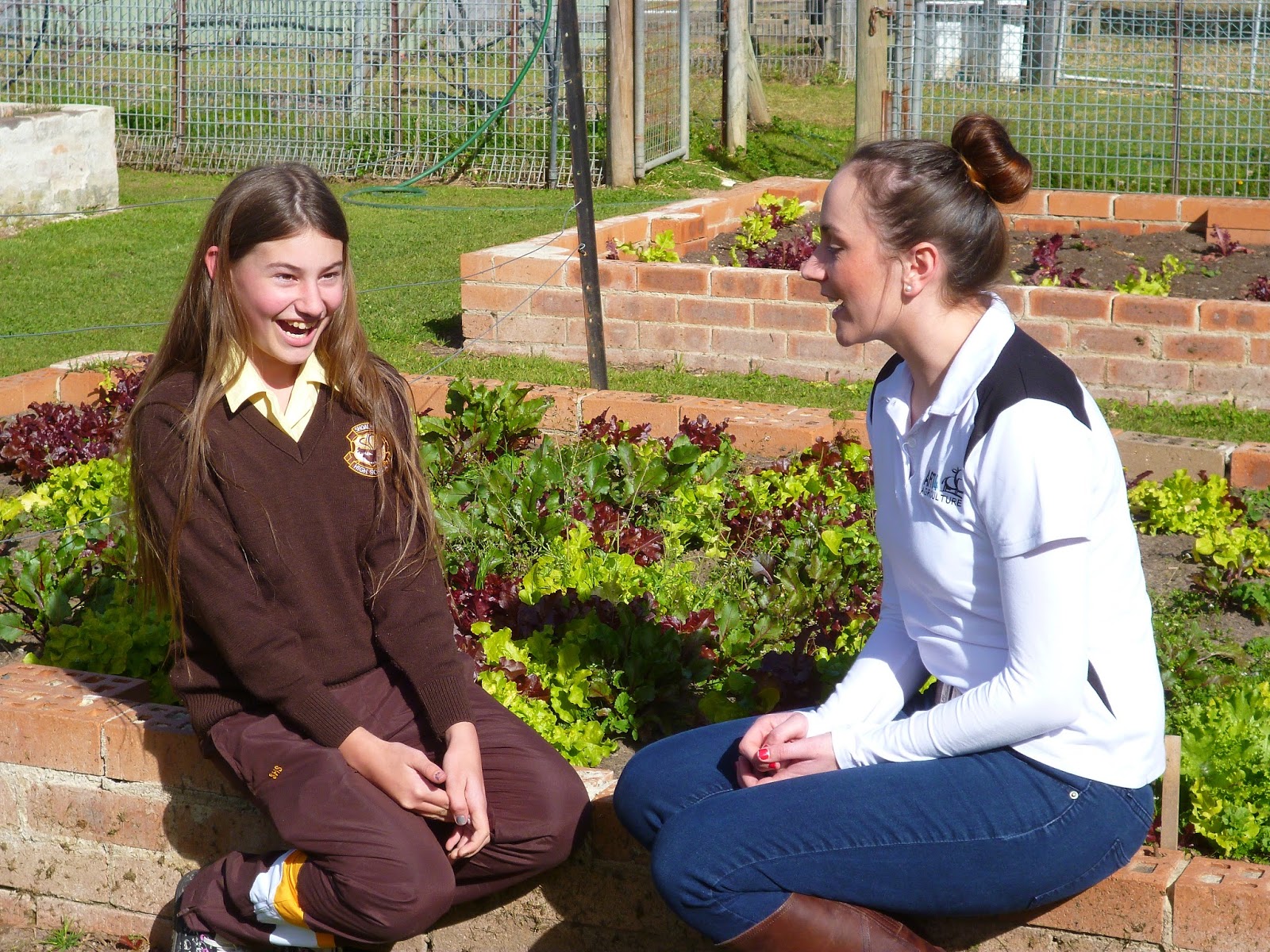
The Amazing Jess Monteith - Our Young Farming Champion

Jess and the Shoalhaven High Team
Chloe and Jess sharing a laugh


Jess Monteith is our allocated Young Farming Champion for the Archibull Prize this year. Jess has her own stud that she has started called Curramore Park with Holstein and Illawarra dairy cows. Her Holstein cow Eve is 6 years old, has had 4 calves and is currently producing 52 litres of milk a day. Clarie is a 4 year old Illawarra that has had 3 calves and is currently producing 39 litres of milk a day. Together her two cows feed 320 people, their daily calcium needs everyday!! Jess is excited because she has just had her first heifer calf after a long run of bull calves.

Dairy cows eat an incredible 40 kg of food each day. This is made up of 10 kg of grain, 25 kg of grass, 5 kg dry hay or silage, which is washed down with 150 litres of water. That would be the same as eating 200 sandwiches and drinking 250, 600mL bottles of water!!!!!

Jess has also worked with the charity Hands Across NSW, to deliver fodder and clothing to farmers out west doing it tough in the drought. She was recognised as the Young Shoalhaven Citizen of the Year in 2012 for her amazing effort. She has also been awarded Berry Showgirl for 2013 and came 3rd at the Royal Easter Show.

Jess loves dairy cows and enjoys the opportunity to work with young people to educate them about the importance of Australian farmers and agriculture and how lucky we are to be able to have all the food and fibre choices available for us to consume. We had a lot of laughs with her and we were amazed at how many people her two cows were able to fed every day.

WATCH OUR VIDEO OF OUR VISIT AND INTERVIEWS WITH JESS at the link below

http://www.youtube.com/watch?v=-OEQOUZ1MaQ&feature=em-share_video_user 


                                                       Marni videos Jess being interviewed by Rebekah

                                                                   Rochelle and Jess


                                                         Ashlee videos Marni interviewing Jess


                                                                    Deborah and Jess